Posts

Showing posts with the label Government

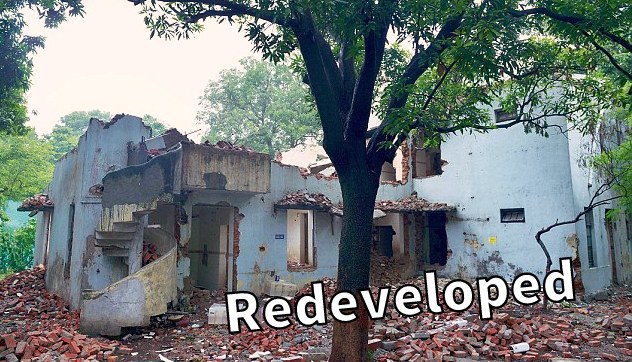
Refugees of Redevelopment: Who Gives a Fuck?
Image
12 th August, 2016: In today's mumbai Mirror, there's this frontpage story headlined, " Buyers Hire Rock Climbers to Enter Flats that Builder won't Hand Over ". One empathizes with the desperation that triggered a dozen home buyers in Powai's Tej society, a redevelopment project of Shwet Realtors ... but their adventurous act is likely to land them into trouble. Yes, this move succeeded in focusing public attention on the plight of the home owners and the defaults of Shwet Realtors in particular, but nevertheless, the police will probably register an FIR for "House Trespass" and related offences against the home-buyers and the rock-climber, and promptly issue arrest warrants. The fact that the redeveloper delayed possession of the flats for years will not cut ice, because the police or magistrate view the builder's actions as a "civil dispute", and the buyers' actions as a "criminal offence". Bottomline: Our system i...

Layman’s Guide to RTI Act 2005 Part 6: Understanding RTI Rules

Maharashtra Government‘s RTI Rules are almost identical with Central Government’s RTI rules, with only tiny differences. The rules are: Form of application. RTI application should generally be filed in format given as Annexture A of the Rules. Word limit and subject: Each RTI application should only be about one subject, and the queries or requests under the heading ‘Description of Information‘, should not exceed 150 words. You can file additional RTI applications on same subject, if your queries exceed 150 words, or you want information on more than one subject. For Central government, the word limit is 500 words. Application fee. Application fee of Rs.10/- are to be paid by affixing Court Fee Stamp or Indian Postal Order (IPO) or bank’s demand draft or banker’s cheque in favour of public authority from whom information is sought, or in cash at the concerned office against receipt. Copying charges. Information in A-3 o...

Layman's Guide to Right to Information Part 1: How to Use Information from RTI?

1. What is Right to Information (RTI)? Right to Information means our right to get information from “public authorities”. Broadly speaking, RTI means that We The People have the right to procure copies of documents from State and Central Government, and other organizations that are controlled, or substantially owned and financed by the government. Right to Information Act 2005 (RTI Act 2005) is called the “Sunshine Act” , because it helps people like you and I -- the citizens of India – to make the government transparent. Also, just as sunlight destroys germs, the Sunshine Act helps the common man to fight against corruption, and to fight for getting his rights from various government authorities, and also from government-regulated private parties such as suppliers of various goods and services, builders and contractors, utility companies, etc. 2. What does RTI Act say? In a nutshell, the Right to Information Act says that any citizen of India has the righ...

Modi Sarkar, focus on quick judicial reliefs to common man

Image
Modi-sarkar should pluck the LOW-HANGING FRUITS to give quick reliefs to the common man -- such as eliminating "anaadi courts" where lakhs of people are mistreated daily and robbed of their self-respect and freedom. Installing CCTV cameras and voice recorders in all courts would be a good way to prevent mistreatment and exploitation of the common man by magistrates, judges, public prosecutors and police. Like  ·  Comment  ·  Share

How Govt. of India uses & recycles judges of High Courts & Supreme Court

Image
The judiciary as an institution is only as good as its judges... and judges, being human, can easily be offered temptations by government. Judges nearing retirement age hear PILs against government, knowing that after retiring, they may be given lucrative & prestigious jobs by government. So they openly favour government and politicians, and frown at public interest litigants and activist citizens. Judicial independence can exist under ideal conditions... but conditions in India are far from ideal. Like  ·  Comment  ·  Share

CORPORATES are the secret organ of state

Image
Every schoolchild is taught that there are three organs of state, namely Legislature, Executive & Judiciary. What they don't teach is that there is a fourth organ -- a secret one: CORPORATES. Companies. Also known as Big Business. They are the ruling classes. We The People are the masses. Unknown to us, the corporate sector is closely involved with every legislature that is elected, and every government that is formed. It funds every political party in mostly secret ways, and  it extracts its price in ways that you and I will never realize. Companies get a huge advantage from being a "legal person", from having huge budgets for giving bribes to political parties, individual legislators and government officials. The sort of white-collar criminality that companies routinely get away with is so large and so widespread, that it is invisible. For instance, telecom, power, insurance and building construction companies have made cheating customers into such a rout...

Why GOVERNMENT does not criticize the judiciary

Image
Sarkaar shares a cozy relationship with the judiciary, particularly with the important judges who hear Writ Petitions & PILs. Neither Govt. of India nor any state government wants judiciary to become a truly effective checks-and-balance mechanism in our democracy. In fact, the more slow and unresponsive judiciary is, the easier it becomes for any sarkaar to keep common people and activists under control! Judiciary is a crowd-control mechanism that enables the State to suppress the people who dissent. It is NOT a justice mechanism. This is a sad reality that We The People must work hard to change. Like  ·  Comment  ·  Share

Judicial remedies in India are for the rich, not for the common man

Image
Aren't judicial remedies like those patented cancer drugs that aim to generate huge profits for multinational drug companies, rather than save the lives of the masses? In India (and other countries also), the judiciary enables big lawyers to get rich, without helping the masses to get justice. Chief justices, judges, magistrates, public prosecutors and government pleaders are all riding on this gravy train. Some get riches, others get glory and power... and the poor masses get only false hopes and tareekh pe tareekh! Like  ·  Comment  ·  Share

While giving thorns to the Government, aren’t we forgetting to present roses?

Image
[I wrote this in June 2011, when Arvind Kejriwal, Anna Hazare, Kiran Bedi, Prashant Bhushan and Baba Ramdev were together in India-Against-Corruption or the Lokpal Movement. I think it still holds today.]  Dear All, I have asked this question before, a couple of years ago, to the activist  junta . And I am asking this question afresh in the context of Anna Hazare’s campaign Jan Lokpal Bill, as well as Baba Ramdev’s campaign for bringing back money stashed abroad, because I smell the stench of self-righteous pride in our midst. Baba Ramdev and Anna Hazare may be well meaning citizens, but their speech and actions — and the actions of their followers — are increasingly marred by an arrogance that is self-defeating and ridiculous. They are deluding themselves and the people of India into taking an untenable stand. In recent years, I have visited several municipal offices, government offices, police stations, State Information Commissions etc. to collect replies to RTI...